


Pursue continual improvement in environmental performance issues, such as water stewardship, energy use and climate change.
Nature
Responsibly produced minerals and metals play a critical role in meeting global development goals, but this cannot be at the expense of nature.
At a time when the health of our natural world is at risk but demand for minerals and metals is on the rise, ICMM members are committed to contributing to a nature-positive future. This means taking urgent action across all areas of the industry’s influence: at direct operations, across the value chain, in surrounding landscapes and through supporting transformation of the fundamental systems that contribute to nature loss.
Issue at a glance
- Nature is essential for human health, wellbeing, livelihoods, and the economy. It underpins the achievement of the UN Sustainable Development Goals and is both affected by and influences climate change.
- Nature is being lost at an unprecedented rate, requiring urgent efforts to avoid exceeding environmental tipping points with severe consequences for people, economies, and ecosystems.
- Businesses have a crucial role to play in aligning their operations with global efforts to protect biodiversity, integrating nature-positive strategies into decision-making and fostering sustainable development.
- As demand for critical minerals rises, the mining and metals sector must balance increased activity with the responsibility to minimise environmental impact, prioritise restoration, and contribute to nature-positive solutions.
- Conserving, restoring and ensuring the sustainable use of nature requires a whole of society approach. This means the participation of Indigenous Peoples and local communities, cross-sector collaboration, robust metrics, and immediate action guided by science and traditional knowledge.
- Mineral and metal resources are finite, meaning that the lifespan of any mine is limited. Planning for closure from the point of designing the project is key in ensuring that impacts to air, soil, water, and ecosystems local to the site are minimised, and post-closure land use opportunities and social transition outcomes are optimised.
ICMM company member commitments
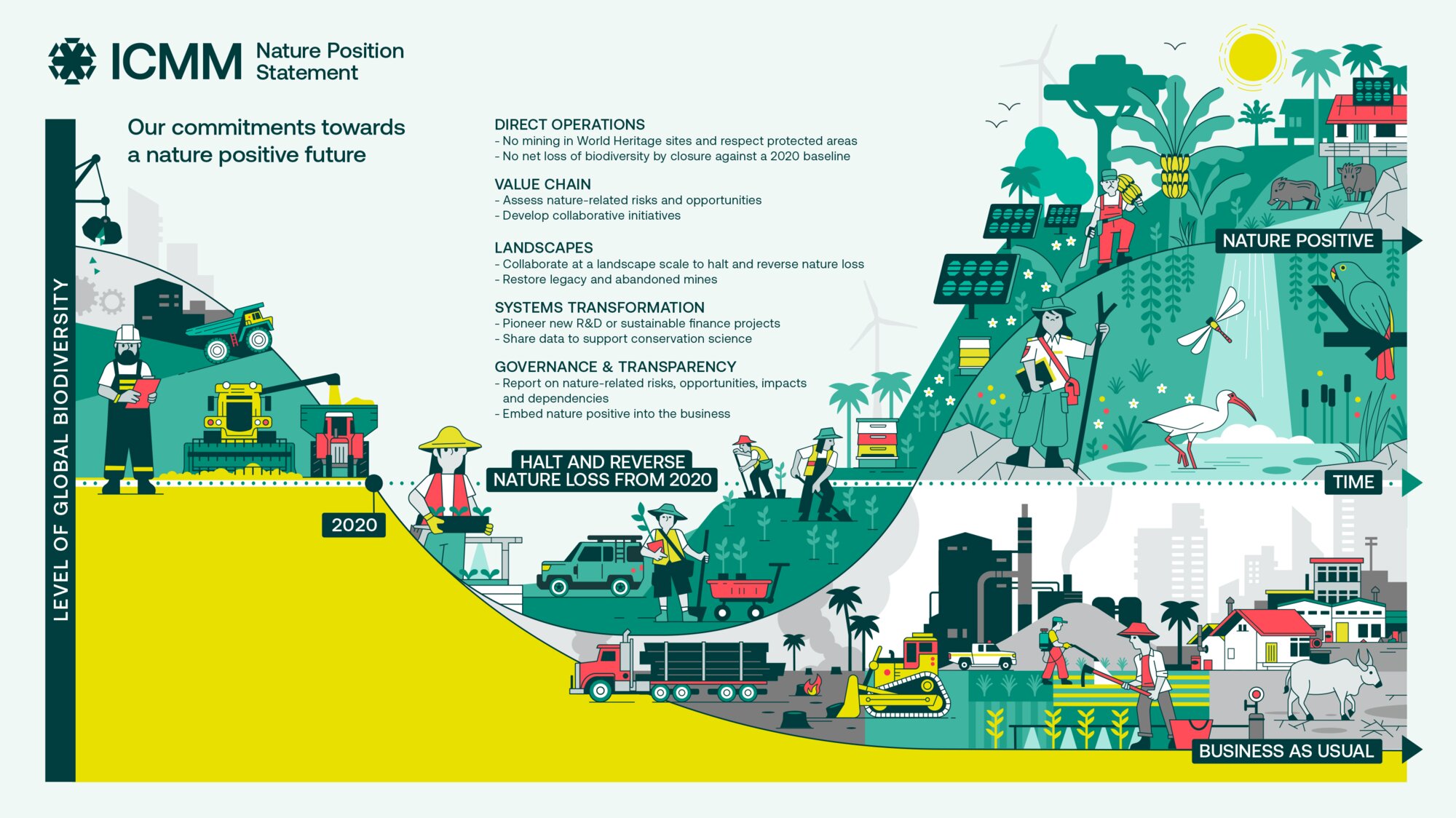
Taking urgent action to halt and reverse nature loss is vital to achieving the Sustainable Development Goals and reaching global decarbonisation targets. In January 2024 ICMM launched a new Position Statement: Nature which includes commitments to:
- Protect and conserve pristine areas of our natural environment: No mining or exploration in World Heritage Sites and respect all legally designated protected areas.
- Halt biodiversity loss at our operations: Achieve at least no net loss of biodiversity at all mine sites by closure against a 2020 baseline.
- Collaborate across value chains: Develop initiatives and partnerships that halt and reverse nature loss throughout supply and distribution chains.
- Restore and enhance landscapes around operations through local partnerships, including with Indigenous Peoples, land-connected peoples and local communities.
- Catalyse wider change: Acting to change the fundamental systems that contribute to nature loss and fostering opportunities for nature’s recovery.
Our priorities
The mining industry is highly dependent on nature, from water provision to supply chain continuity. Our members are working to ensure that their actions to reduce dependencies on nature and support healthy resilient ecosystems are appropriate to the different landscapes in which they operate and optimise their influence across multiple scales. The ICMM nature commitments represent a unique collective sector approach to share learnings, co-deliver initiatives and drive better outcomes for nature at pace.
-
Direct operations
ICMM members are committed to applying the mitigation hierarchy at operations to achieve at least no net loss of biodiversity across all sites from a 2020 baseline. This requires members to do all they can at the earliest feasible stages of project development to support the restoration of nature as soon as possible.
- Achieving no net loss (NNL) of biodiversity is a core foundation of nature-positive action and ICMM members are already implementing NNL approaches at their sites.
- We have developed practical guidance to support achieving no net loss (NNL) or a net gain (NG) of biodiversity at mining operations. We will continue to support our members’ implementation of this approach through training, peer-to-peer knowledge sharing and translating and making our guidance available to the wider sector via our website.
-
Value chains
The broader mining and metals value chain (upstream and downstream) also impacts nature, with the task of identifying and mitigating these impacts often being complex. ICMM members are committed to partnering with suppliers, customers and key stakeholders to support action across the value chain to understand and mitigate nature-related impacts, risks, dependencies, and opportunities.
- ICMM members are committed to working with key suppliers with significant nature-related risks to establish sourcing locations using a range of approaches.
- A variety of emerging geo-spatial and block-chain traceability tools also exist and may offer the potential to access and independently verify sourcing locations.
- Regulatory pressure such as the EU Corporate Sustainability Reporting Directive (CSRD) as well as value chain reporting requirements across the Global Reporting Initiative (GRI) and Taskforce for Nature-related Financial Disclosures (TNFD) are creating additional momentum that will drive greater disclosure of key sourcing locations.
-
Landscapes
Working to restore and enhance landscapes around operations through local partnerships, including with Indigenous Peoples, land-connected peoples and local communities.
- Landscape-level collaboration with a number of stakeholders such as Indigenous and land-connected people and local communities, protected area managers, agri-business and other corporations has a huge potential to reduce nature-related risk and restore, conserve or even enhance biodiversity and ecosystem services.
- ICMM is committed to ensuring landscape activities are implemented in partnership with stakeholders in the landscape to conserve, restore and sustainably use nature, whilst ensuring that initiatives addressing the loss of nature are meaningful, equitable and include those that are likely to be most affected in the decision making. To enable and fast-track collaborative action, ICMM is rolling out regional knowledge sharing workshops, convening members from geographically similar regions who may face common challenges. The series serves as a platform for knowledge sharing and dialogue, fostering connections and collaboration to tackle shared issues and accelerate solutions workshops to identify solutions and partnerships to address critical challenges.
-
Systems transformation
Acting to change the fundamental systems that contribute to nature loss and fostering opportunities for nature’s recovery. Nature commitments in this area are designed to maximise positive contributions in line with the local context. These actions could be related to: collaborative research and development, data sharing or sustainable finance.
- Good quality data that allows us to understand both the state of nature and what is driving its loss will be foundational to delivering a nature positive future. ICMM members collect and analyse biodiversity data to assess, plan and monitor biodiversity related management interventions. ICMM members are already engaged in several initiatives that promote date sharing.
- In January 2025, ICMM, in collaboration with the International Network for Acid Prevention (INAP), released the Tool for Acid Rock Drainage and Metal Leaching Prevention, aiming to drive cross-sector collaboration in tackling the systemic challenge of managing acid rock drainage and its associated environmental impacts.
-
Governance and transparency
Integrating nature considerations into business decision making is key to enable systemic change in how we understand and manage nature. ICMM members are committed to driving this change, with the governance and transparency commitments offering a tool to progress the integration of nature into all business culture.
- Our nature commitments are supported by transparent disclosures on performance outcomes, including publishing the results of nature-related impact and dependency assessments, and setting targets to address these.
- ICMM, as the Taskforce on Nature-related Financial Disclosures’ (TNFD) official piloting partner supported four of our members as ‘early adopters’ to pilot test and input into the development of the TNFD framework. We also supported the development of the Additional sector guidance – Metals and mining as an important tool towards catalysing a shift to an economy that supports nature. Read more about how TNFD is shaping nature-positive outcomes here.
- Several of our members have since adopted the TNFD framework in their nature disclosures while others are reporting against Global Reporting Initiative's (GRI) Topic Standard for Biodiversity or are captured under the requirements for the EU Corporate Sustainability Reporting Directive (CSRD).
Key resources
Associated member commitments




Principle 07: Conservation of Biodiversity
Contribute to the conservation of biodiversity and integrated approaches to land-use planning.

Position Statement: Nature
Nature loss is a critical global challenge, placing the survival, health, wellbeing and livelihoods of people, ecosystems, and our global economy at significant risk.

Position Statement: Climate Change
Responding to the need for an urgent global response to the threat of climate change, across all areas of society and the economy.
Position Statement: Water Stewardship
Promoting the use of water in ways that are socially equitable, environmentally sustainable, and economically beneficial.
Latest updates


Supporting the SDGs
With our strong focus on sustainable development there is great potential for ICMM to support the mining and metals industry in making an important and lasting contribution towards the UN’s global goals. We work with members and partners to catalyse lasting social and economic progress that supports an end to poverty, protects the planet, and ensures prosperity for all.
-
SDG 2: Zero hunger
Mining operations in traditionally agricultural areas can affect water, land, and biodiversity resources, which may lead to conflicts with farmers and local communities. Companies operating in regions with chronic malnutrition, particularly among children, can mitigate their impacts by minimising land use and enabling community access to managed lands that provide essential food sources. Collaboration with development agencies to address hunger and support food security, including through micronutrient supplementation, can further enhance their contribution.
-
SDG 6: Clean water and sanitation
Water is critical for mining operations and employee wellbeing, but poor water management can harm access and quality for surrounding communities. Companies must adopt sound water stewardship practices to balance operational needs with community and environmental sustainability.
-
SDG 13: Climate action
Mining can address climate change by reducing emissions and integrating adaptation measures into strategies and policies. As coal-fired power generation remains a significant carbon emitter, advancements in technologies like carbon capture and storage are critical. Mining operations must also enhance community resilience to the physical impacts of extreme weather.
-
SDG 14: Life below water
Mining activities that interact with oceans – such as shipping, shallow seabed mining, and waste disposal – can affect marine ecosystems. Companies must identify and mitigate marine impacts, support conservation efforts, and consider the needs of communities reliant on marine resources.
-
SDG 15: Life on land
Mining and its associated infrastructure can disrupt ecosystems and biodiversity. The mitigation hierarchy – avoid, minimise, restore, enhance, and offset – provides a framework for addressing these impacts. As stewards of extensive land areas, mining companies have a responsibility to contribute to biodiversity conservation and sustainable land management.


